
September 10th, 2026
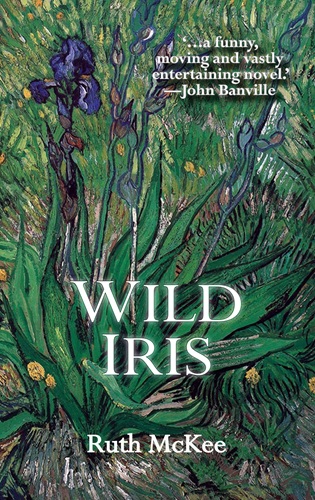
We interviewed author Ruth McKee to find out more about her dark but humorous novel, Wild Iris.
How much of Wild Iris is autobiographical? In particular, did any of the characters (Eve, Louise, Johnny, Gerty, or even Mrs. McKendry's very detailed suicide) come from people or experiences in your own life?
It’s always tempting to think an author is writing about their own experiences, and it’s a question that historically women have been asked much more frequently than men (that old line ‘men invent, women confess’). I read an interesting interview with Sebastian Barry in The Irish Times recently where he says ‘I don’t feel like a writer. I feel like a rememberer of things that never happened.’ I relate to that description—for me there is an odd alchemy of imagination and memory when it comes to writing fiction. I’m fond of Zadie Smith’s advice: ‘Tell the truth through whichever veil comes to hand—but tell it.’
How much of the novel was shaped by your own experiences of living in Co. Antrim and later in Dublin? Did the places themselves, or your memories of them, influence the way you created the settings and Eve’s story?
The novel doesn’t mention places by name specifically; the book is set in an imaginary coastal town in Co. Antrim, and its mirror in Co. Dublin. The cities, both north and south, are not named either. None of these places exist (or do they, now that they’ve been imagined?), although there are fragments in the novel which are inspired by real places. The past is another country for Eve, and there is a kind of abstract dreaminess to where she grew up, somewhere both instantly recognizable but also otherly. Rupture is important in the novel in several ways—not least because Eve leaves the place where she grew up not to return for twenty years.
The structure of the novel feels very deliberate. Eve’s fragmented memories move between her childhood, her university years, and the present, with the significance of what we learn gradually building throughout the novel. What drew you to this structure, and how did you decide when to reveal each piece of information to the reader?
The novel mirrors how Eve’s mind works, it flits from one thought to another, so there is a stream-of-consciousness but not one that the reader flounders in; an idea or word at the end of one chapter bleeds into the next, so while we move in time and space, the narrative feels tight and connected. We inhabit Eve’s interiority as she slinks into despair throughout the c ourse of a day and night: the narrative mimics this by gradually beginning to unanchor.
I didn’t plan the story as such, it emerged during many rewritings—I knew what I wanted the novel to do, what the heart of the book was—but the plot was probably the last thing that fell into place; it’s the least interesting part of the process for me. Or as Edna O’Brien put it rather more succinctly in a Paris Review interview: ‘Well, fuck the plot! That is for precocious schoolboys. What matters is the imaginative truth.’ Having said that, I did wonder if it was possible to write literary fiction that was also a page-turner. It turns out that writing ‘hard and clear about what hurts’ is quite difficult, or to misquote the late great Dolly Parton, it took a lot of work to look that easy.
The ending of Wild Iris is devastating, but also somewhat ambiguous. What did you want that final moment to leave readers feeling or wondering about Eve?
I won’t say too much about the ending, as it’s a question the book builds towards, but it reveals just as much about the reader as anything else: like much in life, you see the world not as it is, but as you are.
What drew you to the central premise of a 42-year-old woman with a child who is contemplating suicide?
I am interested in duality, how it can be entirely possible to appreciate beauty in the world, to be teeming with curiosity, to pay attention to moments of joy, yet also be in great psychological pain. Eve is wounded, lonely, carrying around baggage from her childhood and early adulthood that is taking its toll. How does a person come to face that ultimate decision, whether to live or die? Alongside this I think there has to be some levity in a novel; Eve’s observations can be quite witty, despite her despair. This might be a northern thing, many of us who grew up in The Troubles and post Troubles have a tendency towards dark humour. John Banville famously said that art should be serious, but never solemn.
Was it challenging to immerse yourself in the mind of a woman contemplating suicide and to explore the world through Eve’s thoughts and experiences?
Like many authors, I find writing a release, a catharsis, and deeply satisfying. Inhabiting child-Eve was beautiful—I was able to see things as if for the first time again, but it also came with an ache, one which carries through to Eve when we meet her as an adult on the brink of a devastating decision. I cried when I wrote the ending—but if I’m allowed another quote, no tears in the writer, no tears in the reader.
Buy the book from Amazon.co.uk and visit the publisher's website, Dedalus Books.
_________________________________________________________________